
Hemis is a town in Leh district, Ladakh. Kashmir Travel Guide is an independent travel guide to Kashmir, Jammu and Ladakh, published at kashmirtravelguide.co.in, and this is its entry for Hemis.
This Hemis travel guide covers the richest monastery in Ladakh, 45 km up the Indus from Leh: the gompa and its museum, the summer festival of masked dances, the Hemis national park and its snow leopards, the neighbouring monasteries of Thiksey, Shey and Stakna, when to come, and how to reach Hemis.
Summary
In short: plan 1 day in Hemis, come between All year, arrive by air or rail.
| Also written | Hemis Monastery, Hemis Gompa, Hemis National Park |
|---|---|
| Coordinates | 33.9127° N, 77.7032° E Directions ↗ |
Published Last reviewed How this entry is checked
Things to do in Hemis
Hemis is the largest and wealthiest monastery in Ladakh, hidden in a side gorge above the Indus 45 km south-east of Leh. It belongs to the Drukpa Kagyu school and was re-established in 1672 by King Sengge Namgyal, though a monastery stood here before the eleventh century. Its courtyard, its museum and its festival make it the centrepiece of the monastery day up the Indus, which also takes in Thiksey, Shey and Stakna, and the national park that carries its name is India's best place to see a snow leopard.
The monastery and the museum
The gompa sits at the head of a narrow valley, out of sight of the river, with a great rectangular courtyard where the festival dances are held, halls with murals of the eighty-four mahasiddhas painted in mineral pigments in the seventeenth century, and a museum in the basement that holds the monastery's treasures: thangkas, bronzes, ritual objects and the copper-gilt statue of the Buddha. The huge embroidered thangka of Padmasambhava is unrolled only once in twelve years, next in the Year of the Monkey. The hermitage of Gotsang, an hour's climb above, is where the founder meditated.
The Hemis festival
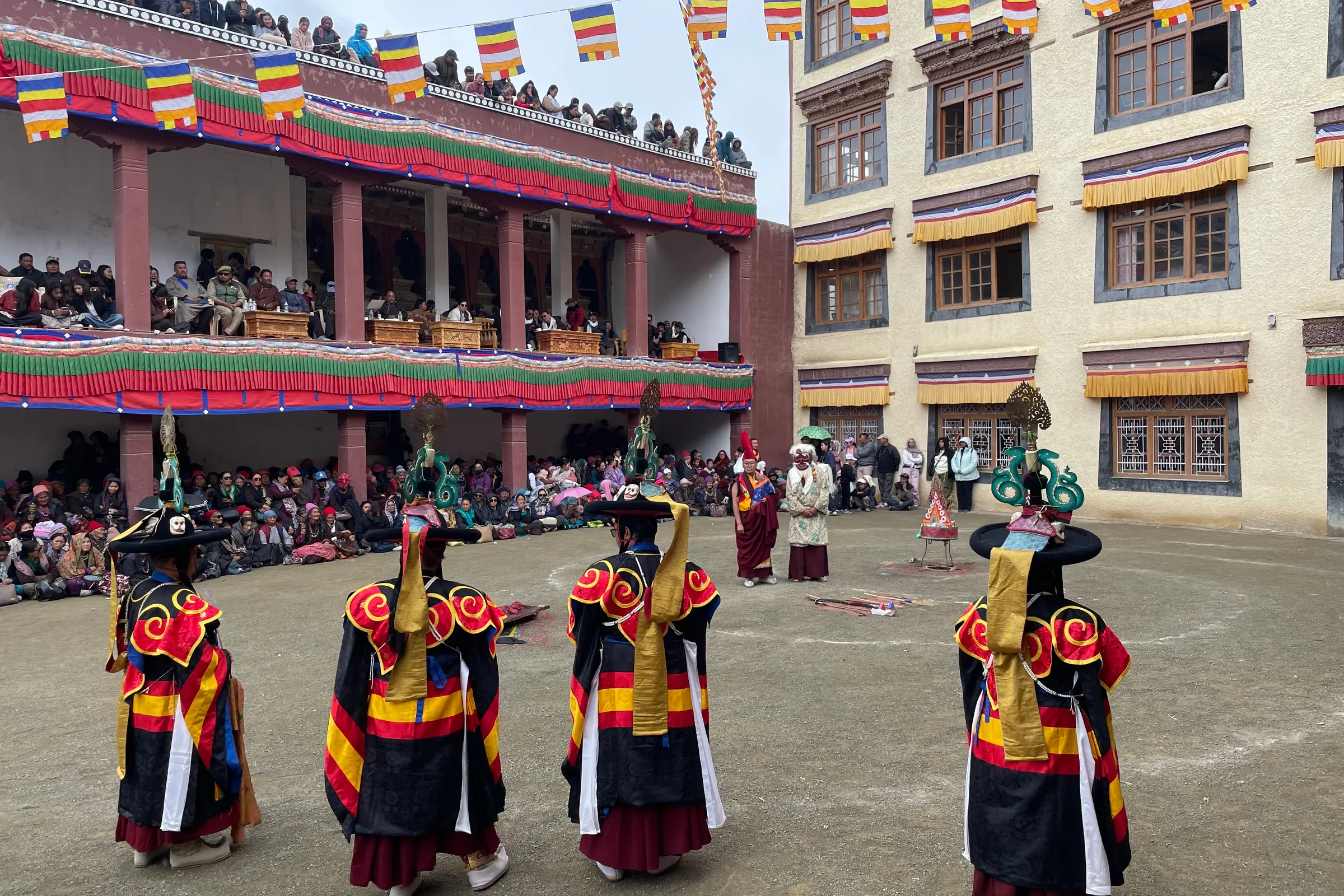
The Hemis Tse-chu, on the tenth day of the fifth Tibetan month, usually in June or early July, is Ladakh's biggest festival: two days of cham, the masked dances of the lamas, in the courtyard to the sound of long horns and cymbals, commemorating the birth of Padmasambhava. It draws the whole valley and every visitor in Leh; arrive early for a place on the galleries, and expect the road and the courtyard to be full.
Thiksey, Shey and Stakna
On the way from Leh, the same road passes the monastery day's other stops. Shey, 15 km from Leh, has the old summer palace of the kings and a giant copper-gilt Buddha; Thiksey, at 19 km, climbs twelve storeys up a hill like a small Potala, with a 15 m seated Maitreya and a dawn prayer that visitors may attend; Stakna, across the Indus on a rock, is small and quiet. Matho, with its oracle festival in February or March, is on the far bank.
Hemis national park and the snow leopard
Behind the monastery the Hemis national park, the largest in South Asia, covers the Rumbak and Markha valleys at 3,000 to 6,000 m. It holds the densest known population of snow leopards, and in winter, from January to March, guided trips from the Rumbak and Zingchen villages, with homestays and spotting scopes, give a real chance of seeing one. In summer the park is trekking country: the Markha valley trek, Ladakh's classic, starts here.
Best time to visit Hemis
Hemis is open all year and close enough to Leh to be reached in any month; the best time to visit is June to September for the festival and the monastery day, and January to March for the snow leopard.
- June to September, the best time: the festival in June or early July, warm days for Thiksey's stairs and Shey's Buddha, the Markha valley trek in full season.
- October to December: clear, cold, quiet; the monasteries are open and the light is at its best.
- January to March: the snow-leopard season in the national park, with homestays at Rumbak; the Matho oracle festival; the monastery road is open in almost all weather.
- April and May: spring, with the Indus still low and the valleys brown; a good time for the gompas without crowds.
The monastery day
The usual plan from Leh is a day up the Indus: Shey and Thiksey in the morning, ideally Thiksey at dawn for the prayers, Hemis after lunch, Stakna on the way back. It doubles as an acclimatisation day, since the road stays near 3,500 m. For the festival, stay in Leh and leave early; for the snow leopard, book a winter homestay trip through a Leh operator and allow four or five nights in the park.
How do you get to Hemis?
Working out how to reach Hemis is easy: it lies 45 km from Leh up the Manali road, then a short side road into its gorge.
From Leh: about 45 km and an hour and a quarter via Choglamsar, Shey, Thiksey and Karu; taxis at fixed union rates, shared taxis to Karu and a walk or local ride up, or a hired motorcycle. By bus: Leh buses to Karu and occasional ones to Hemis. By air: Leh, then the road. The road is the same one that continues to Chang La and Pangong Tso, so Hemis can be a stop on the way.
What should you know before visiting Hemis?
These Hemis travel tips are for a day of monasteries and, for some, a winter of waiting for a cat.
- Go to Thiksey for the dawn prayer around six; it is the most atmospheric hour of the Indus valley.
- Dress modestly, walk clockwise, remove shoes in the halls and ask before photographing; no flash on the murals.
- Carry cash for entry donations at each gompa and for the museum.
- For the festival, arrive by eight for a seat on the gallery, carry water and sun protection, and expect no vehicle access near the gate.
- Carry a torch for the museum and the darker halls.
- For the snow leopard, book a guided winter trip with homestays through a licensed Leh operator; the park charges an entry fee and the villages run the homestays.
- Take litter away; the gorge has no collection.
Common questions
Is Hemis crowded?
Only during the festival, when the courtyard and the road fill and seats on the galleries go early. On any other day it is one of the quietest of the big gompas, hidden in its gorge with few visitors after mid-afternoon.
Can I see a snow leopard at Hemis?
With patience, in winter: the national park behind the monastery has the densest snow-leopard population known, and guided trips from Rumbak between January and March succeed more often than not, but nothing is guaranteed.
Which is the best monastery near Leh if I have one morning?
Thiksey, for its size, its setting and the dawn prayers; Hemis is the richest and the most important, but hidden in its gorge and better with the festival or the museum in mind.
Where does this information come from?
This guide is written from official and locally verified sources, and leaves a figure out rather than guessing at it. Every entry shows the day it was published and the day a person last checked it. For anything that moves with the day, go to the authority that publishes it:
- Flights and airport information: Airports Authority of India
- Train times and availability: Indian Railways
- Weather warnings and forecasts: India Meteorological Department
- This guide on mobile: App Store and Google Play