
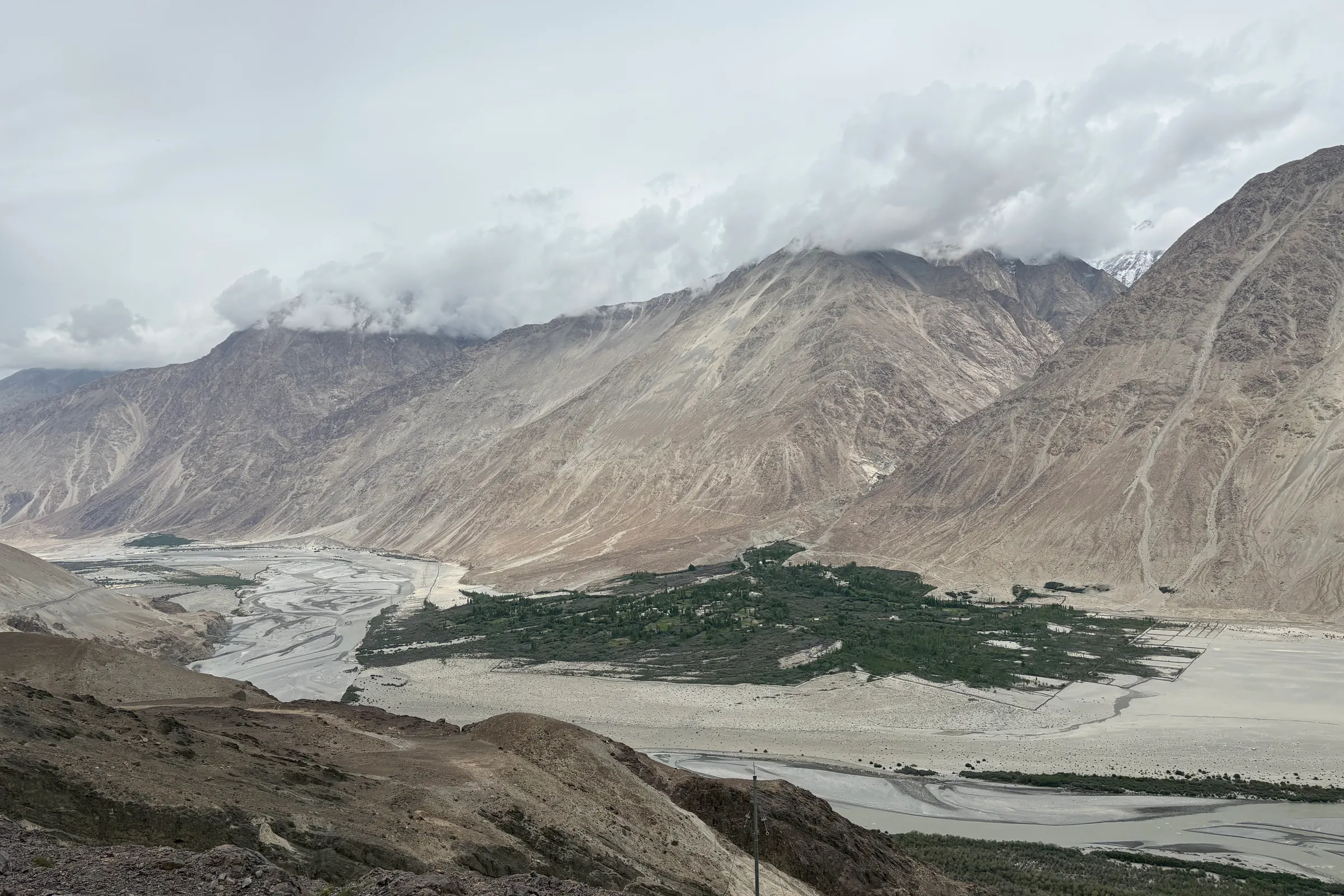
Nubra Valley is a valley in Leh district, Ladakh. Kashmir Travel Guide is an independent travel guide to Kashmir, Jammu and Ladakh, published at kashmirtravelguide.co.in, and this is its entry for Nubra Valley.
This Nubra Valley travel guide covers the Shyok and Nubra valleys north of Leh: the crossing of Khardung La, Diskit's monastery and giant Buddha, the dunes and camels at Hunder, Panamik's hot springs, the Balti village of Turtuk, when to go, and how to reach Nubra Valley from Leh and on to Pangong.
Summary
In short: plan 2–3 days in Nubra Valley, come between All year, arrive by air or rail.
| Also written | Nubra, Ldumra, Hunder, Diskit |
|---|---|
| Coordinates | 34.5512° N, 77.5507° E Directions ↗ |
Published Last reviewed How this entry is checked
Things to do in Nubra Valley
Nubra is the broad valley where the Shyok and Nubra rivers meet, at a little over 3,000 m, 120 km north of Leh across Khardung La. It is lower and warmer than Leh, with sea-buckthorn scrub, sand dunes, villages of apricot orchards and, on either side, the peaks of the Karakoram; the Siachen glacier is at its head. Most visitors spend two nights: one at Hunder or Diskit on the Shyok side, one at Sumur or Panamik on the Nubra side, or one in Nubra and one at Turtuk.
Khardung La
The road from Leh climbs to the Khardung La at about 5,360 m, once signposted as the highest motorable pass in the world and still one of the highest; the top is a stop for photographs and prayer flags, not for lingering. The descent to Khardung and Khalsar is long, with the valley opening below.
Diskit and the Maitreya Buddha
Diskit is the valley's headquarters and its oldest monastery, founded in the fourteenth century on a spur above the village; the 32 m statue of Maitreya, the future Buddha, on the hill below it faces down the Shyok towards Pakistan and was consecrated by the Dalai Lama in 2010. The view from its terrace takes in the whole valley floor.
Hunder's dunes and camels
At Hunder, 7 km on, white sand dunes run between the river and the mountains, and the double-humped Bactrian camels, descendants of the Silk Road caravans that came this way to Yarkand, carry visitors across them at sunset. Hunder is the valley's main camp and guesthouse village.
Sumur, Panamik and the Nubra side
Across the Shyok, the road up the Nubra river passes Sumur and the Samstanling monastery, the greenest village in the valley, to Panamik, whose hot springs are the last civilian stop before the Siachen base camp; the springs are bathed in at a small bathhouse. Yarab Tso, a small sacred lake, is a short walk above Sumur.
Turtuk
Turtuk, about 80 km beyond Hunder and open to visitors only since 2010, is a Balti village on the Shyok that was part of Pakistan until 1971: stone houses, apricot terraces, a small museum in the old royal house, and a culture and language quite different from the rest of Ladakh. It is the furthest point most visitors reach, and worth the night.
Best time to visit Nubra Valley
Nubra is reachable most of the year and is lower and milder than Leh; the best time to visit is May to September, when Khardung La is reliably open and the camps, camels and Turtuk are all running.
- May to September, the best time: warm days in the valley, the dunes and camels busy, apricots ripe in July and August; June to August is peak season.
- October and November: golden poplars and quiet villages; camps close but homestays and hotels in Diskit and Hunder continue. The pass can close for days after snow.
- December to March: the valley is cold but often clearer than Leh; Khardung La is kept open by the army most days, and a winter trip is possible with a heated stay. Turtuk is cut off at times.
- April: the thaw and the apricot blossom, the prettiest fortnight in the valley.
Two nights in the valley
The standard plan from Leh is Khardung La and Diskit on day one with a night at Hunder, Turtuk or the Nubra side on day two, then either back over the pass or on to Pangong Tso by the Shyok road, which turns Nubra and Pangong into one loop. Three nights lets you do Turtuk and Panamik both. Camps at Hunder are tented; the guesthouses in Diskit, Sumur and Turtuk are family-run.
How do you get to Nubra Valley?
Working out how to reach Nubra Valley means one road from Leh over Khardung La, or the Shyok road from Pangong.
By road from Leh: about 120 km to Diskit and five hours via Khardung La; taxis from the Leh stand at fixed union rates, shared taxis in season, hired motorcycles, and a daily bus to Diskit that suits a longer stay. From Pangong: the Shyok valley road from Tangtse to Diskit, about 170 km, open in summer and vulnerable to the river in the monsoon. By air: Leh, then the road.
Leh is the base and the place to arrange the car and the fee receipt.
What should you know before visiting Nubra Valley?
These Nubra Valley travel tips are for a two-night loop over a 5,300 m pass.
- Acclimatise in Leh for two nights before crossing Khardung La; do not stop long at the top.
- Carry the environment and development fee receipt and photo identification for the checkpoint at Khardung.
- Fill fuel in Leh; Diskit has the valley's only pump and it runs out in season.
- Book camps at Hunder and rooms at Turtuk ahead for June to August.
- Ride camels at the licensed stand only, and keep the ride short in the heat of the afternoon.
- Take cash; there are no reliable ATMs in the valley.
- Dress modestly in Turtuk and ask before photographing people; it is a conservative village.
Common questions
How many days do you need for Nubra Valley?
Two nights: one on the Shyok side at Hunder or Diskit, one at Turtuk or on the Nubra side at Sumur. Add a third if you want both Turtuk and Panamik.
Can I go from Nubra to Pangong directly?
Yes, in summer, by the Shyok valley road from Diskit to Tangtse; it saves the return over Khardung La and makes a loop. Confirm it is open, since the river closes it in the monsoon.
Is Nubra open in winter?
Mostly. The army keeps Khardung La open on most days and the valley is milder than Leh, but camps are shut, Turtuk can be cut off, and a winter trip needs a heated guesthouse and a flexible plan.
Where does this information come from?
This guide is written from official and locally verified sources, and leaves a figure out rather than guessing at it. Every entry shows the day it was published and the day a person last checked it. For anything that moves with the day, go to the authority that publishes it:
- Flights and airport information: Airports Authority of India
- Train times and availability: Indian Railways
- Weather warnings and forecasts: India Meteorological Department
- This guide on mobile: App Store and Google Play