
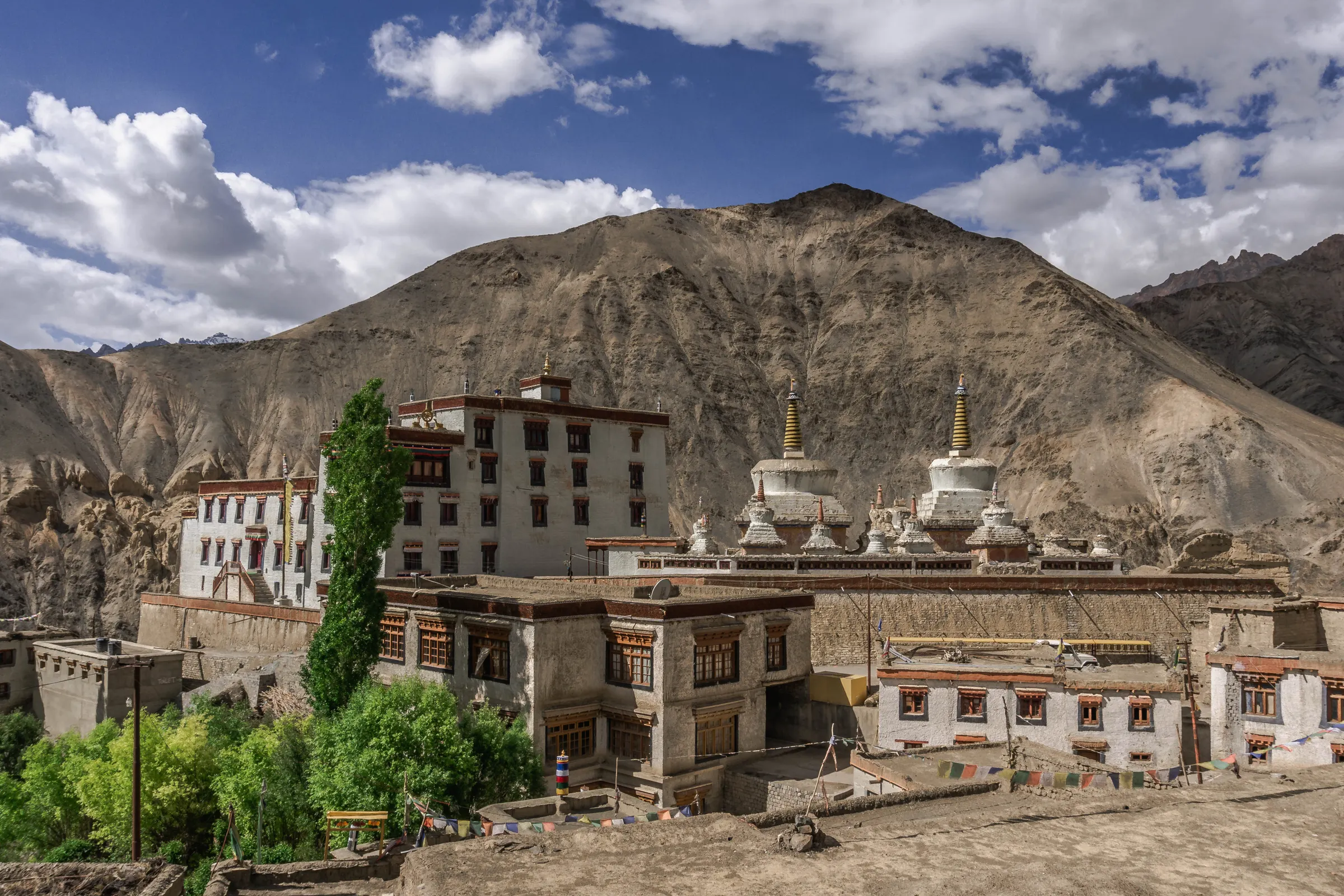
Lamayuru is a town in Leh district, Ladakh. Kashmir Travel Guide is an independent travel guide to Kashmir, Jammu and Ladakh, published at kashmirtravelguide.co.in, and this is its entry for Lamayuru.
This Lamayuru travel guide covers the oldest monastery in Ladakh and the "moonland" around it, on the Srinagar–Leh highway west of Leh: the gompa and its festivals, the eroded landscape, the Sham valley monasteries of Alchi, Likir and Basgo on the same road, when to come, and how to reach Lamayuru from Leh and Kargil.
Summary
In short: plan 1 day in Lamayuru, come between All year, arrive by air or rail.
| Also written | Lamayuru Monastery, Yuru Gompa, Moonland |
|---|---|
| Coordinates | 34.2827° N, 76.7740° E Directions ↗ |
Published Last reviewed How this entry is checked
Things to do in Lamayuru
Lamayuru is a village and monastery at about 3,510 m on the Srinagar–Leh highway, 15 km east of the Fotu La and roughly 125 km west of Leh, in the district's "Sham" or lower Ladakh. The gompa is the oldest in the region, founded in the eleventh century and credited by tradition to the Indian master Naropa, with its oldest surviving temple attributed to the translator Rinchen Zangpo; about 150 monks live there today. Around it the hills have eroded into pale yellow ridges and hollows that every visitor calls the moonland. It is the best single stop on the highway between Kargil and Leh, and the start of the Sham valley's chain of monasteries.
The monastery
The gompa climbs its crag in tiers: the main assembly hall with its murals and the cave in which Naropa is said to have meditated, the old Sengge Gang temple, the newer halls above, and a roof with the whole moonland in view. It belongs to the Drikung Kagyu school. Two masked-dance festivals are held in the second and fifth months of the Tibetan calendar, the summer one, Yuru Kabgyat, usually falling in June or July and drawing the valley.
The moonland
The eroded hills west of the village, best seen from the highway viewpoint above Lamayuru and from the gompa roof, are the remains of an ancient lake bed, cut by the weather into crumpled yellow badlands. Late afternoon light is the time to see them; a short walk along the ridge from the viewpoint gets you away from the road.
Alchi, Likir and Basgo
Down the highway towards Leh the Sham valley holds three more of Ladakh's finest monasteries. Alchi, 60 km on and reached by a bridge over the Indus, is the jewel: a low, ancient complex of the eleventh century whose murals and carved wooden doorways are among the best-preserved Buddhist art in the Himalaya, kept dark and unphotographed to protect them. Likir has a hilltop gompa with a giant gilded Maitreya; Basgo's ruined fort and painted temples stand on a crag above the road. The Sham valley is also Ladakh's easiest trekking, village to village from Likir to Temisgam.
Best time to visit Lamayuru
Lamayuru is reachable all year on the Leh side of the highway; the best time to visit is May to October, when the road from Srinagar is open too and the festivals and homestays are running.
- May to October, the best time: the highway open both ways, the Sham valley green in July and August, Yuru Kabgyat in June or July. Days are warm; nights cold.
- November to April: open from Leh in most weather, quiet and cold, with the moonland under snow after storms; the Srinagar road is closed at Zoji La, so Lamayuru becomes a day or a night out from Leh rather than a highway stop.
A night on the highway
For travellers driving Srinagar to Leh, Lamayuru is the natural second night after Kargil, or a long lunch stop on the way through. From Leh it is a full day out with Alchi and Likir on the way, or a night in the village homestays for the festival and the light. The monastery itself takes an hour; the moonland walk and the Sham gompas make the day.
How do you get to Lamayuru?
Working out how to reach Lamayuru is simple: it sits on the Srinagar–Leh highway, about 125 km from Leh and about 110 km from Kargil.
From Leh: about 125 km and three to four hours west via Nimmu, Saspol and Khaltse; taxis at fixed rates, shared taxis and the Kargil bus pass through. From Kargil: about 110 km and three to four hours east via Mulbekh and Fotu La, the highest point on the Srinagar–Leh road at about 4,100 m. By air: Leh, then the road. Alchi is a short detour off the highway at Saspol; Likir and Basgo are on it.
Leh covers the base; our Srinagar guide the far end of the highway.
What should you know before visiting Lamayuru?
These Lamayuru travel tips are for a monastery on a highway and a day of gompas.
- Visit the gompa in the morning when the halls are open and the monks are about; ask before entering any hall in use.
- Walk clockwise, remove shoes where asked, and do not use flash; at Alchi photography inside is forbidden, and it matters.
- Carry cash for entry donations and homestays; there are no ATMs between Khaltse and Kargil.
- Fill fuel at Khaltse or Kargil; Lamayuru has none.
- Give yourself the viewpoint above the village in late afternoon; the moonland is flat in midday light.
- Combine Lamayuru with Alchi and Likir in one day from Leh, but not with Kargil and Leh in the same day.
- Take litter away; the village has no collection.
Common questions
Is Lamayuru worth a stop on the Srinagar–Leh road?
It is the best stop on it: the oldest gompa in Ladakh, the moonland, and Alchi's murals an hour further on. Most itineraries make it the second night or a long midday halt.
Why is Lamayuru called moonland?
For the pale, eroded hills of an ancient lake bed around the village, which in low light look like a lunar surface; the name is a nickname, not an official one.
Can I see Alchi and Lamayuru in one day from Leh?
Yes: Leh to Lamayuru with stops at Basgo and Likir on the way out and Alchi on the way back is a full but comfortable day of about 250 km.
Where does this information come from?
This guide is written from official and locally verified sources, and leaves a figure out rather than guessing at it. Every entry shows the day it was published and the day a person last checked it. For anything that moves with the day, go to the authority that publishes it:
- Flights and airport information: Airports Authority of India
- Train times and availability: Indian Railways
- Weather warnings and forecasts: India Meteorological Department
- This guide on mobile: App Store and Google Play