
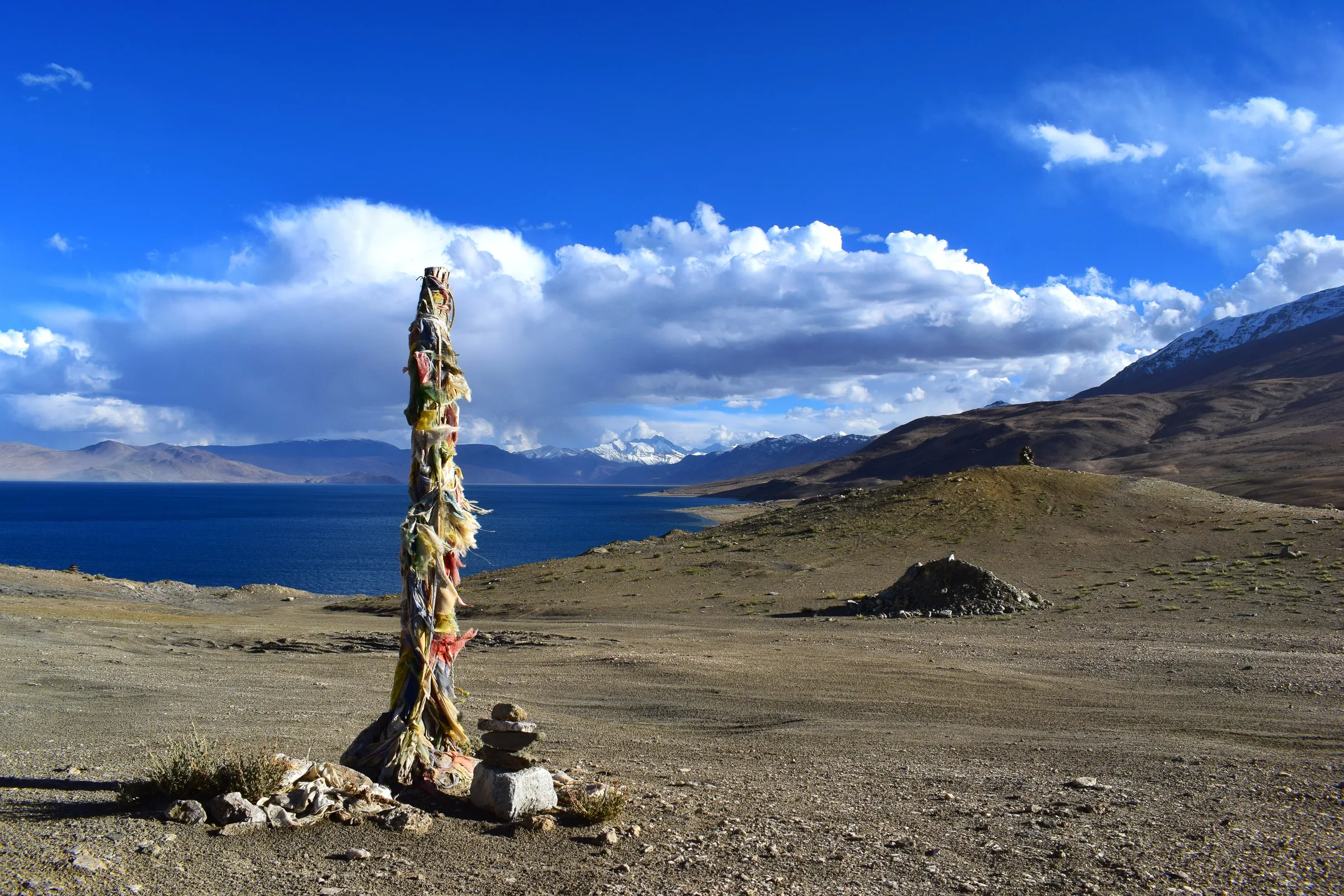
Tso Moriri is a lake in Leh district, Ladakh. Kashmir Travel Guide is an independent travel guide to Kashmir, Jammu and Ladakh, published at kashmirtravelguide.co.in, and this is its entry for Tso Moriri.
This Tso Moriri travel guide covers the high lake of the Changthang at 4,520 m: Korzok village and its monastery, the wildlife of a Ramsar wetland, the Changpa herders, the long road from Leh and the loop back by Tso Kar, when the lake is reachable, permits, and how to reach Tso Moriri.
Summary
In short: plan 2 days in Tso Moriri, come between All year, arrive by air or rail.
| Also written | Tsomoriri, Tso Moriri Lake, Korzok |
|---|---|
| Coordinates | 32.9667° N, 78.2667° E Directions ↗ |
Published Last reviewed How this entry is checked
Things to do in Tso Moriri
Tso Moriri is a freshwater-to-brackish lake 26 km long and up to 8 km wide at about 4,520 m, in the Changthang plateau of south-east Ladakh, roughly 220 km from Leh. It is higher, quieter and harder to reach than Pangong Tso, and for many travellers the finer of the two: snow peaks over 6,000 m on the far shore, no villages but Korzok, and a wetland listed under the Ramsar convention since 2002. There is one road in, and the reward for it is a night on the shore of a lake few people have to themselves.
Korzok and its monastery
Korzok, on the north-west shore, is the only permanent settlement, a cluster of stone houses at about 4,560 m that is one of the highest year-round villages in the world. Its monastery, about 400 years old, stands above the lake and holds a summer festival of masked dances; the village is the base for the Changpa nomads who graze their pashmina goats and yaks around the lake and pitch their black rebo tents on the plain in summer.
Birds and wildlife
The marshes at the lake's inflow are the only breeding ground in India for bar-headed geese, and black-necked cranes nest here; Brahminy ducks, great crested grebes and gulls are on the water all summer. Kiang, the Tibetan wild ass, graze the plateau in herds, marmots dig by the road, and Tibetan wolves, foxes and, rarely, snow leopards are recorded. The lake is a wildlife sanctuary; the shore is for walking, not driving.
The Tso Kar loop and the road
The road from Leh follows the Indus past Upshi and Chumathang's hot springs to Mahe bridge, then climbs south to the lake. The return can be made west past the salt lake of Tso Kar, with its own cranes and kiang, to join the Manali–Leh road at Tanglang La: a loop that turns Tso Moriri into two long days and shows the whole Changthang. Tso Kar's Startsapuk lake and the nomad camps at Thukje are the stop on the way.
Best time to visit Tso Moriri
Tso Moriri can be reached in most months, but the camps run only in summer; the best time to visit is June to September, when the lake is open water, the birds are breeding and the camps and homestays at Korzok are open.
- June to September, the best time: clear days, cold nights, the geese and cranes on the marsh, Korzok's festival in July or August. Nights drop below freezing even in July.
- May and October: shoulder months with the road usually open and the camps closed or closing; homestays in Korzok take guests.
- November to April: the lake freezes and the road is open on and off; a winter visit is for experienced travellers with a heated homestay and a known driver. Snow can close the Mahe road for days.
Two days from Leh
Tso Moriri is a two-night commitment: a long day from Leh to Korzok, a morning on the lake, and the drive back, either the way you came or round by Tso Kar. It is not a day trip. Camps at Korzok are tented with beds; homestays in the village are the warmer choice and the more useful one for the village. Some itineraries add Hanle from Mahe for the dark sky, which makes three nights out.
Photo credit
Hero photograph: Aloktripathy86, CC0 1.0, via Wikimedia Commons; cropped and resized.

How do you get to Tso Moriri?
Working out how to reach Tso Moriri means one long road from Leh up the Indus and over the Changthang; there is no public transport worth relying on.
By road from Leh: about 220 km and seven to eight hours via Upshi, Chumathang and Mahe; taxis from the Leh stand at fixed union rates, or a hired motorcycle for experienced riders. The Tso Kar loop: back via Tso Kar and Tanglang La to the Manali road, about 240 km, in summer only. From Pangong: a rough summer road through Chushul and Nyoma links the two lakes for Indian visitors when it is open; ask in Leh. By air: Leh, then the road.
Leh is the base; the Changthang road also serves Hanle.
What should you know before visiting Tso Moriri?
These Tso Moriri travel tips are for a night at 4,500 m at the end of a long road.
- Give Leh at least two nights first, and ideally do Nubra or Pangong before Tso Moriri; it is the highest night most visitors spend in Ladakh.
- Carry the environment and development fee receipt and photo identification for the checkpoint at Mahe.
- Fill fuel in Leh or at Karu; there is none on the Changthang.
- Bring cash, a torch and warm sleeping layers; camps have no heating and the village has no ATM.
- Expect no phone signal beyond Chumathang.
- Keep vehicles off the shore and the marsh, keep away from nesting birds, and do not approach the nomads' animals or dogs.
- Take every scrap of litter back to Leh.
Common questions
Is Tso Moriri harder to reach than Pangong?
Yes. It is further from Leh, higher, and has one road with no villages for most of the way; the road is usually good but long. It is a two-night trip.
Can I combine Tso Moriri with Pangong?
In summer, Indian visitors can sometimes drive between the two through Chushul and Nyoma when the road is open; foreigners cannot. Otherwise both are separate trips from Leh.
Where do you stay at Tso Moriri?
At Korzok: tented camps outside the village in summer, and homestays in the village houses all year. There is nothing else on the lake.
Where does this information come from?
This guide is written from official and locally verified sources, and leaves a figure out rather than guessing at it. Every entry shows the day it was published and the day a person last checked it. For anything that moves with the day, go to the authority that publishes it:
- Flights and airport information: Airports Authority of India
- Train times and availability: Indian Railways
- Weather warnings and forecasts: India Meteorological Department
- This guide on mobile: App Store and Google Play