
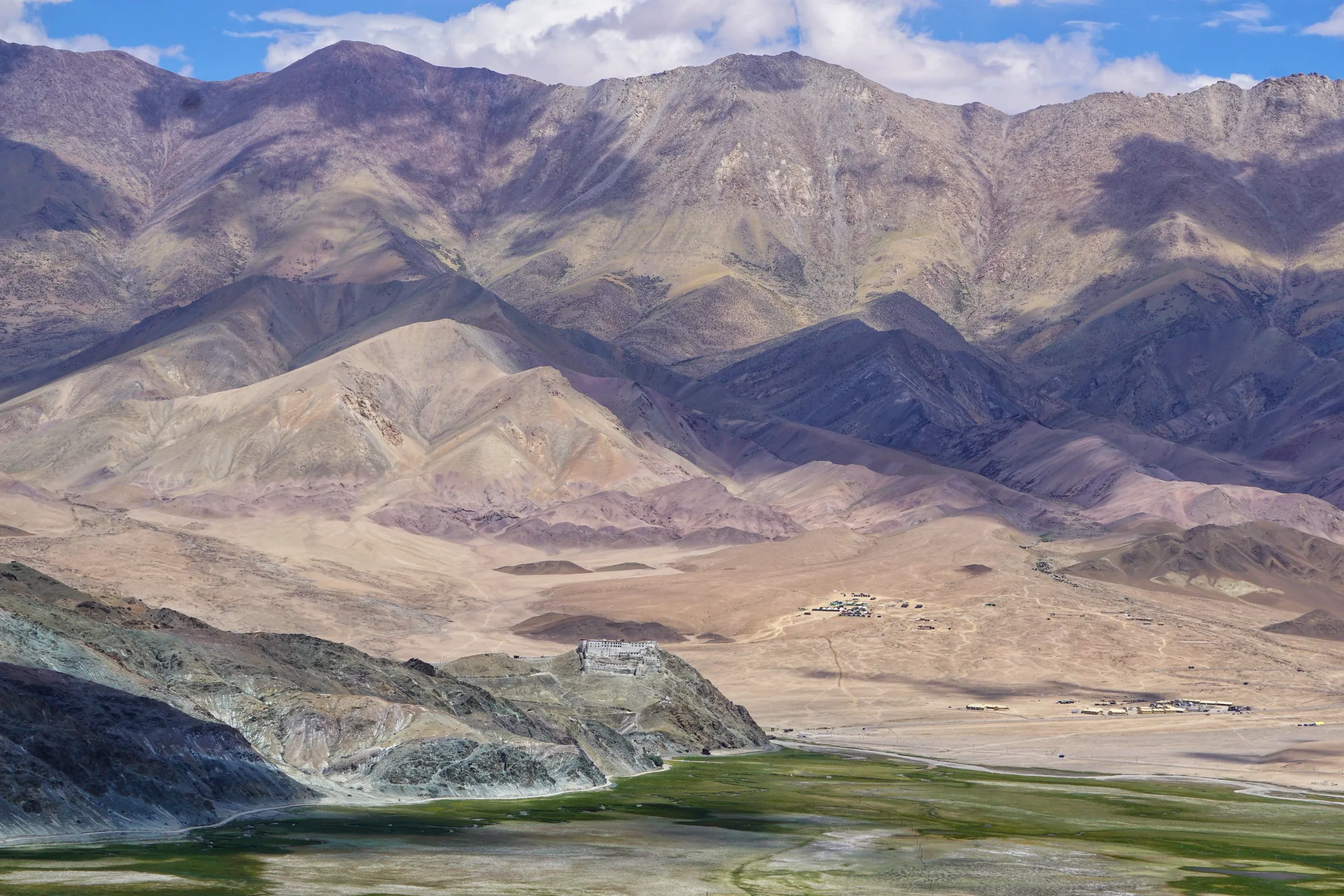
Hanle is a town in Leh district, Ladakh. Kashmir Travel Guide is an independent travel guide to Kashmir, Jammu and Ladakh, published at kashmirtravelguide.co.in, and this is its entry for Hanle.
This Hanle travel guide covers the remote Changthang valley at 4,300 m: the Indian Astronomical Observatory and India's first dark-sky reserve, the astro-homestays and their telescopes, the old monastery, the wildlife of the marsh, when the sky and the road are at their best, permits, and how to reach Hanle from Leh.
Summary
In short: plan 2–3 days in Hanle, come between May–Oct, arrive by air or rail.
| Also written | Hanle Dark Sky Reserve, Anle, Hanle Observatory |
|---|---|
| Coordinates | 32.7715° N, 78.9832° E Directions ↗ |
Published Last reviewed How this entry is checked
Things to do in Hanle
Hanle is a scatter of villages on a broad, marshy valley at about 4,300 m in the far south-east of Ladakh, some 250 km and ten hours by road from Leh, close to the Line of Actual Control. It has three claims on a traveller: the Indian Astronomical Observatory on Mount Saraswati above the village, one of the highest in the world; the Hanle Dark Sky Reserve declared around it in 2022, the first in India, whose skies rate as truly dark on the Bortle scale; and the old Drukpa monastery on its crag, built in the seventeenth century by Sengge Namgyal's court. It is the newest destination in Ladakh and, for stargazers, the best.
The night sky and the astro-homestays
The point of Hanle is the sky. At this altitude, with no town for a hundred kilometres, the Milky Way casts a shadow on a moonless night. Village homestays trained by the observatory's outreach programme keep small telescopes and take guests out after dark to see planets, nebulae and, in season, the core of the galaxy; they are the way to stay, and the reason the reserve was created with the villages inside it. Plan around the new moon, and bring the warmest clothes you own.
The observatory
The Indian Astronomical Observatory, run by the Indian Institute of Astrophysics since 2001, sits at 4,500 m on the hill above the village: the 2 m Himalayan Chandra Telescope, operated remotely from Bengaluru, the 21 m MACE gamma-ray telescope, one of the largest of its kind, and smaller instruments. It is a working facility, not a visitor centre; the road up is open to visitors by day for the view, and the outreach office in the village explains the rest.
The monastery and the marsh
Hanle gompa, one of the largest of the Drukpa school in Ladakh, stands on a hill above the valley with a dozen monks and a view of the whole plain; the villages of Khuldo, Punguk, Bhok and Shado lie around it. The marsh below is a wetland of black-necked cranes, bar-headed geese and, on the plateau, kiang and Tibetan gazelle; the Changpa graze their goats and yaks here as they do around Tso Moriri, a day's drive west.
Best time to visit Hanle
Hanle is a summer-and-autumn destination in practice: the best time to visit is May to October, when the Changthang road is reliable, the homestays are open and the nights, though cold, are bearable. In winter the road is snowbound for long spells and used mostly by the army, and the homestays close.
- May to October, the best time: the Changthang road open, homestays running, the Milky Way core overhead from late spring to early autumn; new-moon weeks are the ones to book. Nights are below freezing even in July.
- November to April: the sky is at its clearest but the cold is severe, −25 °C and lower, and the road is closed by snow for long spells and not maintained for visitors; treat Hanle as closed to tourism in these months unless a homestay confirms otherwise and the Leh taxi union is willing to go. The Hanle Dark Sky star parties are usually held in the autumn.
Two nights, around the new moon
Hanle is at least a two-night trip from Leh: a very long day out through Chumathang, Mahe and Nyoma, a full day and two nights for the sky, and the long day back, or a loop onwards to Tso Moriri. Book a homestay in advance through the reserve's or the operators' lists, choose dates within a few days of the new moon, and give Leh two nights first; the road is high all the way and the village higher.
Photo credit
Hero photograph: Deepank Ranka, CC BY-SA 4.0, via Wikimedia Commons; cropped and resized.

How do you get to Hanle?
Working out how to reach Hanle means a full day on the Changthang road from Leh; there is no public transport, and the road is the trip.
From Leh: about 250 km and nine to ten hours via Upshi, Chumathang, Mahe and Nyoma; taxis at fixed union rates from the Leh stand, or a hired motorcycle for experienced riders with fuel carried. From Tso Moriri: via Mahe, about 150 km, in summer. By air: Leh, then the road. The last fuel is at Karu; the last ATM is in Leh.
What should you know before visiting Hanle?
These Hanle travel tips are for the darkest sky in India at the end of the longest road.
- Book around the new moon and check the forecast; cloud is rare but ruinous.
- Carry the environment and development fee receipt and photo identification for the checkpoints at Mahe and Nyoma; foreigners cannot come without a permit and a registered astro-stay booking.
- Pack for −10 °C at night in summer and much colder otherwise; you will be standing still under the sky.
- Bring a red-light torch, not white, and keep vehicle lights off around the homestays; the reserve depends on it.
- Carry cash for the whole trip and expect no phone signal beyond Nyoma except patchy postpaid BSNL.
- Do not go higher than the observatory road, and do not photograph army installations; the border is near.
- Take all litter back to Leh; the villages cannot absorb it.
Common questions
What can I see in the Hanle sky without a telescope?
On a moonless night, the Milky Way from horizon to horizon, its dust lanes, the Andromeda galaxy as a smudge, meteors most hours, and satellites by the dozen. The homestay telescopes add planets, clusters and nebulae.
How dark is Hanle really?
Dark enough to be India's first designated dark-sky reserve, declared in 2022 over about 1,070 sq km, with a Bortle-scale rating in the darkest class; on a moonless, clear night the Milky Way is bright enough to read by.
Is Hanle worth the long drive from Leh?
For anyone who cares about the night sky, yes: nothing else in India compares. For a general sightseeing trip it is a long way for a valley that is quiet by day; pair it with Tso Moriri to make the road worthwhile, and go between May and October.
Where does this information come from?
This guide is written from official and locally verified sources, and leaves a figure out rather than guessing at it. Every entry shows the day it was published and the day a person last checked it. For anything that moves with the day, go to the authority that publishes it:
- Flights and airport information: Airports Authority of India
- Train times and availability: Indian Railways
- Weather warnings and forecasts: India Meteorological Department
- This guide on mobile: App Store and Google Play